
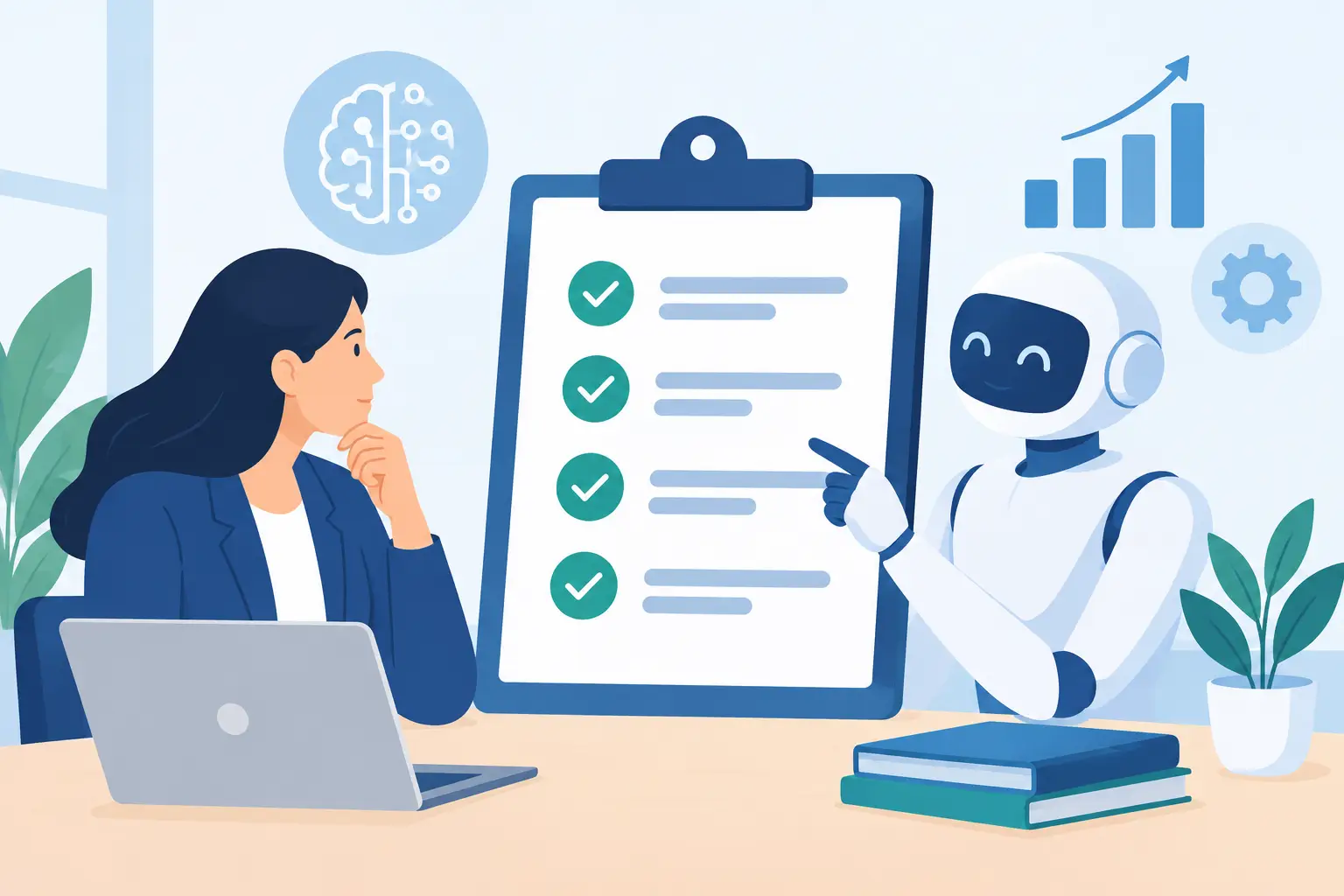
A promising AI demo can make a business problem look solved in 20 minutes. The real test begins when that tool meets incomplete data, legacy systems, unclear ownership, security requirements, and employees who need to use it every day. An AI readiness assessment for businesses separates genuine opportunity from expensive experimentation before leaders commit budget, select vendors, or announce a transformation program.
The goal is not to determine whether a company is “ready for AI” in the abstract. Few organizations are equally prepared across every function, use case, and technology. The goal is to identify where AI can create measurable business value now, what must change before scaling, and who needs to own the work from strategy to execution.
Start With the Business Objective
AI is not a strategy by itself. A useful assessment starts with a defined operating or growth objective: reduce customer response time, increase sales capacity, improve forecasting, shorten document review, accelerate product delivery, or remove manual steps from a high-volume process.
Starting with the objective prevents a common failure mode: selecting a tool because competitors appear to be using it, then searching for a problem it can solve. A better question is, “Where is the business losing time, margin, accuracy, revenue, or customer trust?” That question grounds the assessment in outcomes that executives can measure.
For a growth-stage company, the priority may be building AI-enabled product features without creating technical debt or exposing customer data. For an established company, it may be modernizing a workflow that depends on email, spreadsheets, disconnected systems, and a few employees with institutional knowledge. Public-sector and regulated organizations may place greater weight on auditability, records retention, accessibility, and procurement constraints.
The use case should be specific enough to evaluate. “Use AI in customer service” is too broad. “Reduce first-response time for routine support requests while maintaining escalation controls for high-risk issues” gives the team something concrete to test.
What an AI Readiness Assessment for Businesses Should Measure
Readiness has several dimensions, and a weakness in one area can limit the value of every other investment. A company may have strong data but no accountable process owner. It may have a capable technical team but no approved policy for handling sensitive information. It may have executive enthusiasm but a workflow that was never documented well enough to automate.
A practical assessment evaluates six connected areas.
1. Workflow fit and process maturity
The first question is whether the target process is stable enough to improve. AI can help with variation, judgment support, content generation, classification, extraction, and prediction. It cannot fix a process whose rules change by person, whose inputs are consistently missing, or whose desired outcome is unclear.
Map the current state before designing the future state. Identify triggers, handoffs, systems used, exception paths, decision rights, and measures of success. This work often reveals immediate improvements that do not require AI, such as eliminating duplicate entry or standardizing intake. That is not a disappointing outcome. It is how leaders avoid automating confusion.
2. Data quality, access, and permissions
AI systems depend on data that is usable, relevant, and appropriately governed. The assessment should identify what data the use case needs, where it resides, who owns it, how current it is, and whether it can be accessed through approved methods.
Data volume alone is not an advantage. A small, well-organized knowledge base may support a valuable internal assistant faster than years of fragmented customer records can support a predictive model. Leaders also need to distinguish between data that is technically available and data that is authorized for a given use. Customer contracts, privacy obligations, intellectual property, and industry rules shape that answer.
3. Technology and integration reality
Most valuable AI applications do not operate in isolation. They need to read from a CRM, ERP, ticketing platform, document repository, product database, or communications system. They may also need identity management, logging, API access, monitoring, and a reliable way for humans to review outputs.
An assessment should inventory the systems around the proposed use case and identify integration constraints early. Sometimes the right first move is a limited pilot using existing tools. In other cases, the foundation needs attention first: cleaning up source systems, establishing integration patterns, or replacing a platform that cannot support the required workflow. The right answer depends on the business objective and the cost of delay.
4. Talent, ownership, and adoption capacity
An AI initiative needs more than a technical lead. It requires a business owner who can define the outcome, subject matter experts who understand exceptions, technical talent that can build or integrate the solution, and leaders who can drive adoption.
Assess the workforce honestly. Which capabilities exist internally? Where can current employees be trained? Which roles require a targeted hire, staff augmentation, or specialized project team? A company does not need a large in-house AI department to begin, but it does need clear accountability. When ownership is spread across IT, operations, legal, and a vendor with no decision-maker in charge, projects drift.
Adoption also has a human dimension. Employees need clarity about what the system does, when not to rely on it, how to report errors, and how their work will change. Treating that communication as an afterthought increases resistance and reduces the quality of the rollout.
5. Governance, risk, and trust
Responsible AI governance should be designed around the use case, not copied from a generic policy. A low-risk internal drafting assistant does not require the same controls as a tool influencing hiring, lending, benefits decisions, pricing, safety, or public services.
The assessment should establish acceptable-use boundaries, approval paths, data-handling rules, human-review requirements, audit needs, vendor obligations, and incident response procedures. It should also define how outputs will be tested for accuracy, bias, security issues, and unintended operational consequences.
Controls are not simply a brake on progress. Clear governance lets teams move faster because they know what is permitted, what requires review, and when escalation is required. The trade-off is real: excessive controls can stall useful work, while weak controls can create legal, reputational, and customer risks that outweigh any efficiency gain.
6. Economics and measurement
Every proposed use case needs a value hypothesis. Estimate the current cost of the problem, the expected improvement, implementation expense, ongoing operating cost, and the risks if performance falls short. Include the time required from internal teams, not just software pricing.
The best early use cases often have a combination of meaningful value, accessible data, manageable risk, and a process owner who is motivated to change. They are not always the most visible use cases. A contained workflow that saves 10 hours per week and establishes an integration pattern may be more strategic than a public-facing chatbot that creates broad exposure with uncertain returns.
Define success measures before launch. Depending on the use case, that may include cycle time, resolution rate, conversion, forecast accuracy, error reduction, employee capacity, customer satisfaction, or cost per transaction. Establish a baseline so the organization can distinguish real performance gains from enthusiasm.
Turn Findings Into a Sequenced Plan
A readiness assessment should end with decisions, not a slide deck full of observations. Organize findings into a practical roadmap with three horizons: actions that can begin now, foundation work required over the next several months, and longer-term opportunities that depend on systems, data, or workforce changes.
The first horizon may include selecting one or two pilot use cases, documenting workflows, setting acceptable-use guidance, and assigning executive and operational owners. The second may involve data cleanup, integration work, security reviews, process redesign, and targeted hiring. The third may include embedded AI product capabilities, enterprise-wide automation, or advanced decision-support applications.
Each initiative should have a named owner, budget range, expected outcome, dependencies, and a decision point. A pilot is not successful merely because it is built. It should either meet agreed measures and earn the next investment, reveal a solvable gap, or be stopped quickly. That discipline protects resources and builds organizational confidence.
Use the Assessment to Align the Right Capabilities
Many AI programs fail because strategy, technology, and workforce planning are treated as separate tracks. The operating leader defines a need, IT evaluates tools, legal reviews risk late in the process, and talent needs emerge after timelines are set. The result is fragmented execution.
A stronger approach brings those decisions together at the start. The business objective determines the workflow. The workflow determines the data and system requirements. Those requirements shape the technical plan, governance controls, and team needed to deliver it. This is where strategy and hands-on support must work as one.
Right Fit Advisors approaches this work around the client’s objective, connecting AI strategy, technical execution, and the people required to sustain progress. That alignment matters most when teams need to move quickly without creating a patchwork of disconnected tools and vendors.
The most useful next step is not asking whether your organization is ready for AI. Choose one business problem worth solving, name the leader accountable for the result, and assess what stands between the current workflow and a measurable improvement. That is where a credible AI program begins.