
A generative AI initiative can produce a polished demo in days and still fail to improve the business. The difference is not usually the model. It is whether leaders know how to implement generative AI around a specific operating objective, with accountable owners, usable data, and a plan to change the workflow that surrounds it.
For a founder, that objective may be reducing the time it takes to qualify inbound leads. For an operations leader, it may be helping service teams resolve cases faster without compromising quality. For an established company, it may be modernizing a document-heavy process that has outgrown spreadsheets, inboxes, and disconnected systems. Start there. Technology selection comes later.
Start With the Business Constraint
Generative AI is most valuable when it addresses work that is high-volume, language-heavy, repetitive, and costly to perform manually. It can summarize, classify, draft, extract, search, reason across approved information, and support employees as they make decisions. It should not be treated as a replacement for judgment in areas where accuracy, accountability, or regulatory exposure is high.
Define the current constraint in measurable terms. If a sales team spends six hours each week researching accounts, quantify the time, the number of accounts, and the quality standard. If customer support agents search across five systems to answer common questions, measure average handle time, escalation rates, and customer satisfaction. A precise baseline makes it possible to decide whether the work is worth changing.
Avoid beginning with a broad mandate such as “use AI across the company.” That creates a long list of experiments with no clear owner or economic case. A better approach is to choose one or two workflows where a meaningful improvement can be proven within a defined period, often 60 to 90 days.
Build a practical use-case scorecard
Before committing engineering time, evaluate candidate use cases against a consistent scorecard. Consider the volume of work, expected impact, data readiness, implementation complexity, risk level, and availability of a business owner. A workflow with moderate savings and clean internal data may be a better first project than a high-profile customer-facing assistant that depends on fragmented systems and uncertain policies.
The first use case should be important enough to matter but contained enough to manage. Internal knowledge retrieval, proposal drafting with approved source material, support-agent assistance, and document intake are often stronger starting points than fully autonomous customer interactions.
How to Implement Generative AI From Strategy to Execution
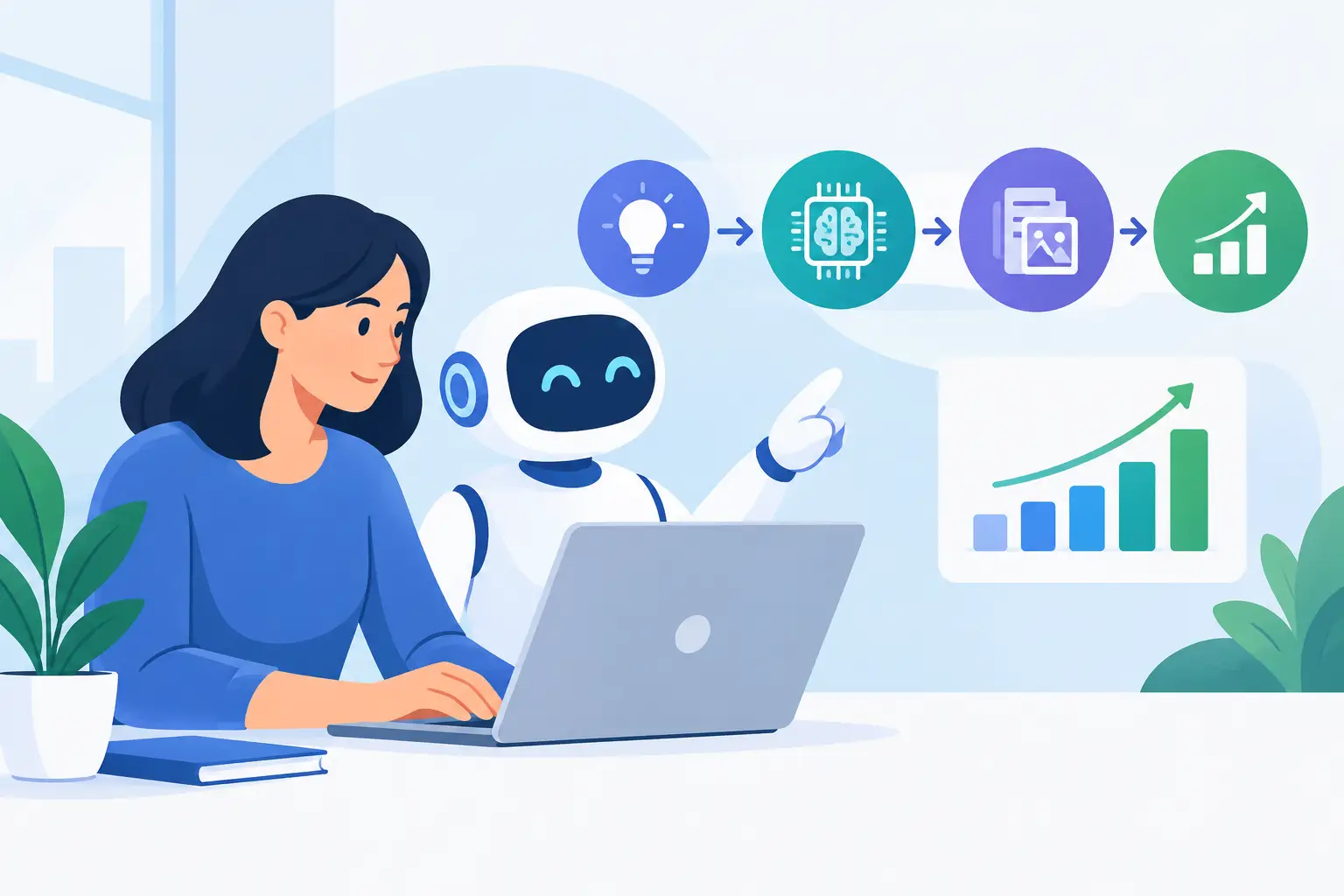
A disciplined implementation follows a simple sequence: understand the workflow, align the people and controls, build the solution, and execute against measured outcomes. Skipping any stage creates avoidable rework.
Understand the workflow before designing the tool
Map how work happens now. Identify the trigger, the inputs, the decisions, the systems involved, the handoffs, and the final output. Ask employees where they lose time, what information they cannot find, and which exceptions require experienced judgment.
This step frequently exposes a larger issue: the workflow itself may be poorly designed. Generative AI can accelerate a weak process, but acceleration is not transformation. If approvals are unclear, source documents conflict, or customer records are incomplete, address those conditions alongside the AI effort.
Then define the role of the AI in plain language. Will it prepare a first draft for employee review? Retrieve answers only from a controlled knowledge base? Recommend a next action while a manager approves it? The narrower the initial role, the easier it is to test quality, establish trust, and set appropriate guardrails.
Align governance, data, and accountability
Responsible AI governance is part of implementation, not a later legal review. The company needs clear decisions about which data can be used, where it can be stored, who can access it, and how outputs will be monitored. This is especially important for personal information, confidential customer data, financial records, regulated industries, and public-sector work.
Create a cross-functional working group with an executive sponsor, a business process owner, technical leadership, security or compliance representation, and the employees who will use the solution. They do not need to meet endlessly. They do need authority to make decisions on scope, data access, testing standards, and rollout.
Establish policies before launch. Employees should know when AI-generated content requires review, which tools are approved, what information must never be entered into a public model, and how to report an inaccurate or harmful response. For high-risk uses, retain human approval for decisions that affect hiring, eligibility, pricing, legal commitments, or customer outcomes.
Choose an architecture that fits the use case
The best model is not always the largest or newest one. Implementation choices should reflect the task, sensitivity of the data, required response time, integration needs, budget, and vendor terms. A simple application using an established model and well-organized internal content may deliver more value than a custom model-training project.
For many business applications, the core design includes a user interface, connections to approved systems, a retrieval layer that grounds responses in current company information, model access, logging, and evaluation tools. Grounding the model in selected internal sources can reduce unsupported answers, but it does not eliminate the need for testing and review.
Build for observability from the start. Teams should be able to see what sources informed an answer, where the system failed, how often users override its recommendations, and what requests fall outside its intended scope. Without this visibility, leaders are left judging a production system by anecdotes.
Test against real work, not impressive examples
A pilot should use a representative set of real tasks, including the messy and unusual cases employees encounter every day. Define success criteria before testing. Depending on the workflow, that may include accuracy, completeness, citation quality, cycle time, adoption, error rates, cost per task, or customer experience.
Compare AI-assisted work against the current process. If the tool drafts a response in 20 seconds but requires five minutes of correction, it may still be useful, but the value case is different. If it cuts research time in half while keeping quality stable, the opportunity is clearer.
Red-team the system as well. Test ambiguous prompts, incomplete records, conflicting documents, attempts to access restricted data, and requests outside the approved role. The goal is not to prove the system perfect. The goal is to understand its failure modes and decide what controls make it acceptable for the intended environment.
Build the Team Around Adoption
Generative AI projects are workforce projects as much as technology projects. A capable solution will underperform if employees do not understand when to use it, do not trust the output, or believe it was imposed without regard for their work.
Involve front-line users early. Their feedback improves prompts, identifies missing information, and reveals where the tool adds friction. Train people on practical judgment, not just prompt writing: how to verify an answer, how to recognize weak output, when to escalate, and how to protect sensitive information.
Some organizations can move with internal product, engineering, security, and operations teams. Others need specialized technical build capacity, data expertise, change-management support, or additional staffing to maintain momentum while the core team continues operating the business. The right model depends on the complexity of the workflow and the organization’s internal capabilities. What matters is clear ownership after the pilot ends.
Measure Value and Expand Deliberately
Do not measure success by logins alone. Track the operational and financial outcomes identified at the beginning: hours saved, throughput, conversion, resolution time, quality, revenue influenced, risk reduction, or employee capacity redirected to higher-value work.
Review results on a regular cadence. Look for adoption gaps, recurring quality issues, rising model costs, stale source content, and new risks created by changes in the workflow. Generative AI applications require ongoing management because the underlying data, user behavior, and model capabilities change.
Expand only after the first use case is stable. Reuse proven components such as access controls, evaluation methods, approved prompt patterns, data connectors, and training materials. This creates a practical foundation for the next workflow instead of a collection of disconnected tools.
The strongest implementations do not begin by asking what generative AI can do. They begin with the work the business must improve, then bring together the right technology, people, controls, and execution discipline to improve it. That is how an experiment becomes sustained business progress.